

When leadership becomes a growth driver: discussion of women's role at KASE
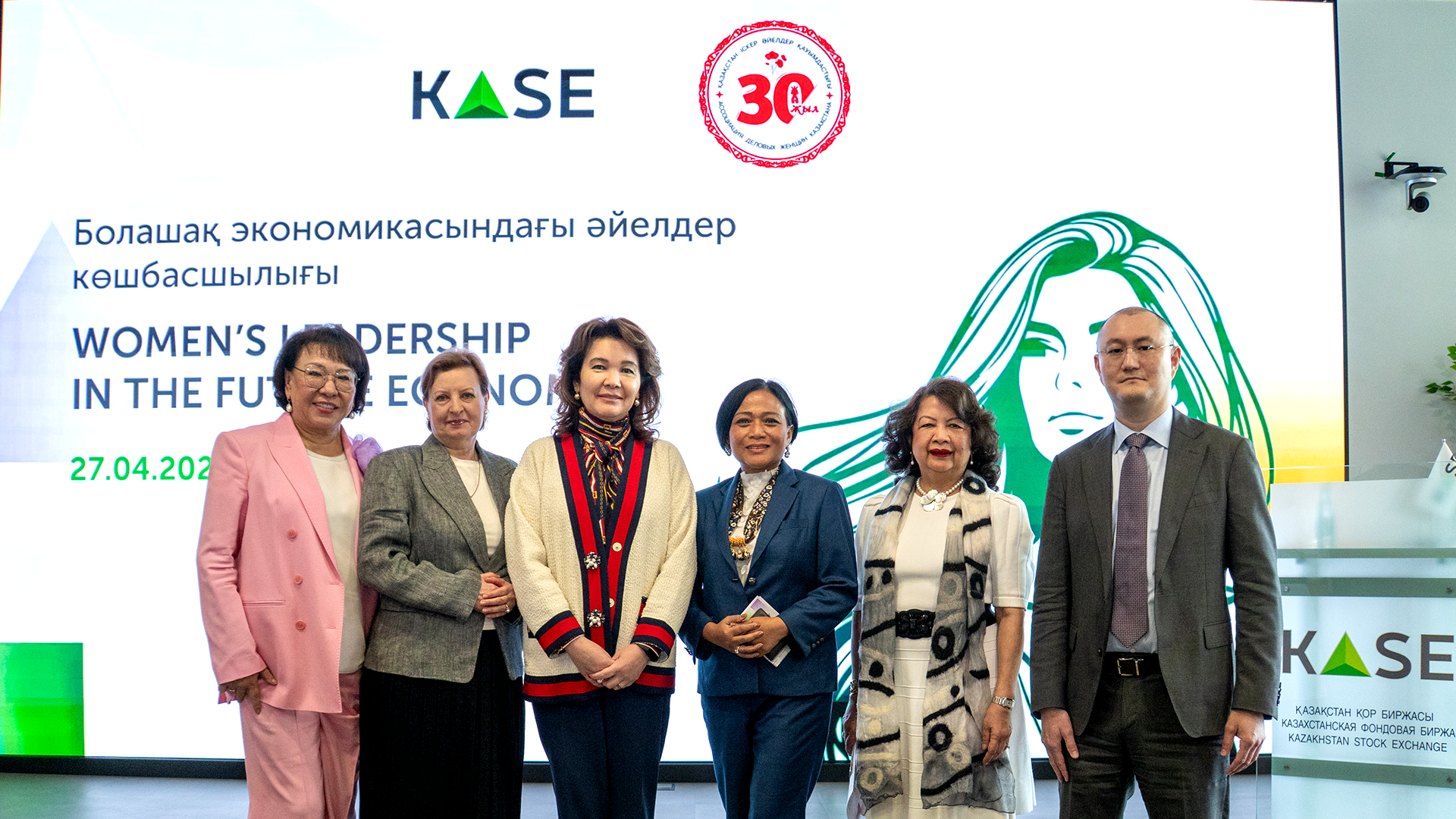
The Kazakhstan Stock Exchange (KASE) hosted a business discussion "Women's Leadership in Economy of the Future" in partnership with the Association of Business Women of Kazakhstan, which brought together more than 60 participants including representatives of the financial sector, international organizations, businesses and the expert community.
Chairperson of the KASE's Management Board Adil Mukhamejanov noted that the topic of women's leadership extends beyond the equal opportunity agenda and is directly linked to quality of economic growth, sustainability of financial systems and competitiveness of countries.
"Our meeting is taking place in a special context: this year, the Association of Business Women of Kazakhstan celebrates its 30th anniversary, a significant contribution to development of entrepreneurship, leadership and institutional participation of women in the country's economy. For KASE, as a key capital market infrastructure, these issues are of practical importance. We see our role not only in ensuring the effective functioning of markets, but also in creating a more sustainable and inclusive economic environment", emphasized the head of KASE.
According to his data, as of the 1st quarter of 2026, the share of women in management positions at KASE was 58%, which indicates a fairly broad presence of women in the management vertical.
Irene Natividad, President of the Global Summit of Women, emphasized that women's contribution to the global economy is already significant, but their potential remains unrealized due to limited access to resources and leadership positions.
"Research shows that about 40% of global GDP is created through women's economic activity. Imagine if we had equal access to pay for work, funding and leadership positions - it would no longer be a share, but a determining force in the global economy", noted Irene Natividad.
According to Yekaterina Benjamin, IFC Country Officer, IFC's programs in Kazakhstan focus on promoting women to boards of directors and management structures and expanding the access to finance, particularly for women in rural SMEs.
"In rural areas, women not only create sustainable businesses, but also form communities, develop local markets and bring people back from cities to villages. At the same time, women’s employment rate is 65-70% compared to 89% for men, while income levels remain lower - on average, around 70% of men’s. Therefore, expanding of access to finance is a key factor for women's full participation in the economy", noted Yekaterina Benjamin.
Yelena Bakhmutova, Chairperson of the Board of the Association of Financiers of Kazakhstan (hereinafter, AFK), also noted that, despite the high proportion of women in small and medium businesses, their growth opportunities are significantly limited due to insufficient access to financing.
"In our country, 48.1% of all SMEs are headed by women. At that, even looking at preliminary estimates, only about 28% of them have access to loans. That is, the gap is already visible. If women received such funding, their contribution to GDP would be much higher", noted Yelena Bakhmutova.
The head of AFK also emphasized that on April 3, Kazakhstan joined the global initiative Women Entrepreneurs Financing Code launched by the World Bank with support of EBRD. This initiative is already active in 40 countries, and a number of financial organizations in Kazakhstan, including Halyk Bank and other institutions, have joined it.
According to her, the significance of this initiative is due to the fact that 48.1% of small and medium businesses in the country are headed by women, making the issue of their access to financing systemically important for the economy.
The head of Halyk Bank Umut Shayakhmetova believes that in Kazakhstan, the main limiting factor for women's careers remains not formal barriers, but rather cultural and mental attitudes. At the same time, the financial sector is already demonstrating a steady transformation: women are actively moving from operational roles to middle and top management levels, including positions of CEO and members of the boards of directors.
"In our financial and banking sector, women already occupy between 43% and 65% of managerial positions. Of the 23 banks, about 10 are also headed by women. We also have women at the head of our financial regulator and the Association of Financiers of Kazakhstan. Until recently, the KASE exchange was also headed by a woman. Therefore, it is difficult for us to say that there are any glass ceilings here", says Umut Shayakhmetova.
Chairperson of the Management Board of KASE Clearing Centre (KACC) Natalia Khoroshevskaya noted that the exchange infrastructure shapes requirements for transparency, equal opportunities and quality of corporate culture, which directly impact career growth and leadership development opportunities.
"When we talk about corporate governance today, we're talking about building corporate rules and a culture that clearly establishes the company's obligation to adopt equal conditions for onboarding of new employees, equal conditions for hiring, equal labor compensation conditions based on an employee's knowledge, qualifications and usefulness, as well as equal conditions for career growth and development of professional and leadership qualities. This is precisely what, in practice, truly helps create equal opportunities for advancement and career growth", says Natalia Khoroshevskaya.
Chairperson of the Management Board of Otbasy Bank JSC Lyazzat Ibragimova emphasized that women in Kazakhstan are actively participating in government housing programs and are gradually forming the basis for financial and property independence.
"Women today represent a huge stratum of economic agents who will determine both GDP growth and development of the financial and stock markets. We see from our bank that we have about 2 million accounts opened by women. And 58% of the deposit portfolio are women who are becoming financially independent and strategically thinking participants in the economy. They know how to plan, save and make long-term decisions, and this is what makes them a crucial factor in Kazakhstan's future economic growth", emphasized Lyazzat Ibragimova.
"It's worth noting that our new Nauryz housing program includes a number of conditions, including absence of housing for the past five years, as well as additional points for participants under 35 who are married and have children. Women make up approximately 70% of the program's participants and are the most active in submitting the applications. According to results of last year, 8,211 of the 16,000 applications were submitted by women”, added Lyazzat Ibragimova.
Rinawati Prihatiningsih, Co-partner and Chief Operating Officer of PT InfinitiBerkan Energy, noted that supporting the female leadership and girls' education form the foundation for future inclusive and sustainable economic growth.
"We are building a talent pool, supporting girls' education, and are confident that our daughters and sisters should become a part of the future leadership. Another important skill is collaboration. In unstable conditions, the ability to work together is especially valuable. I'm glad that men are also here, it's important that they hear about our challenges and abilities. Only through partnership can we achieve sustainable results and ensure inclusive growth", noted Rinawati Prihatiningsih.
The event demonstrated the importance of systematically expanding the role of women in the economy and financial sector as a factor in sustainable growth and development. The discussion concluded with the traditional gong ringing in support of women's leadership.