From tokenization to crypto cards: discussion of new financial reality at Solana Summit Kazakhstan
Solana Summit Kazakhstan 2026, the first international conference dedicated to digital assets, tokenization and fintech development, was held in Almaty. The Kazakhstan Stock Exchange (KASE) served as the event's strategic partner.
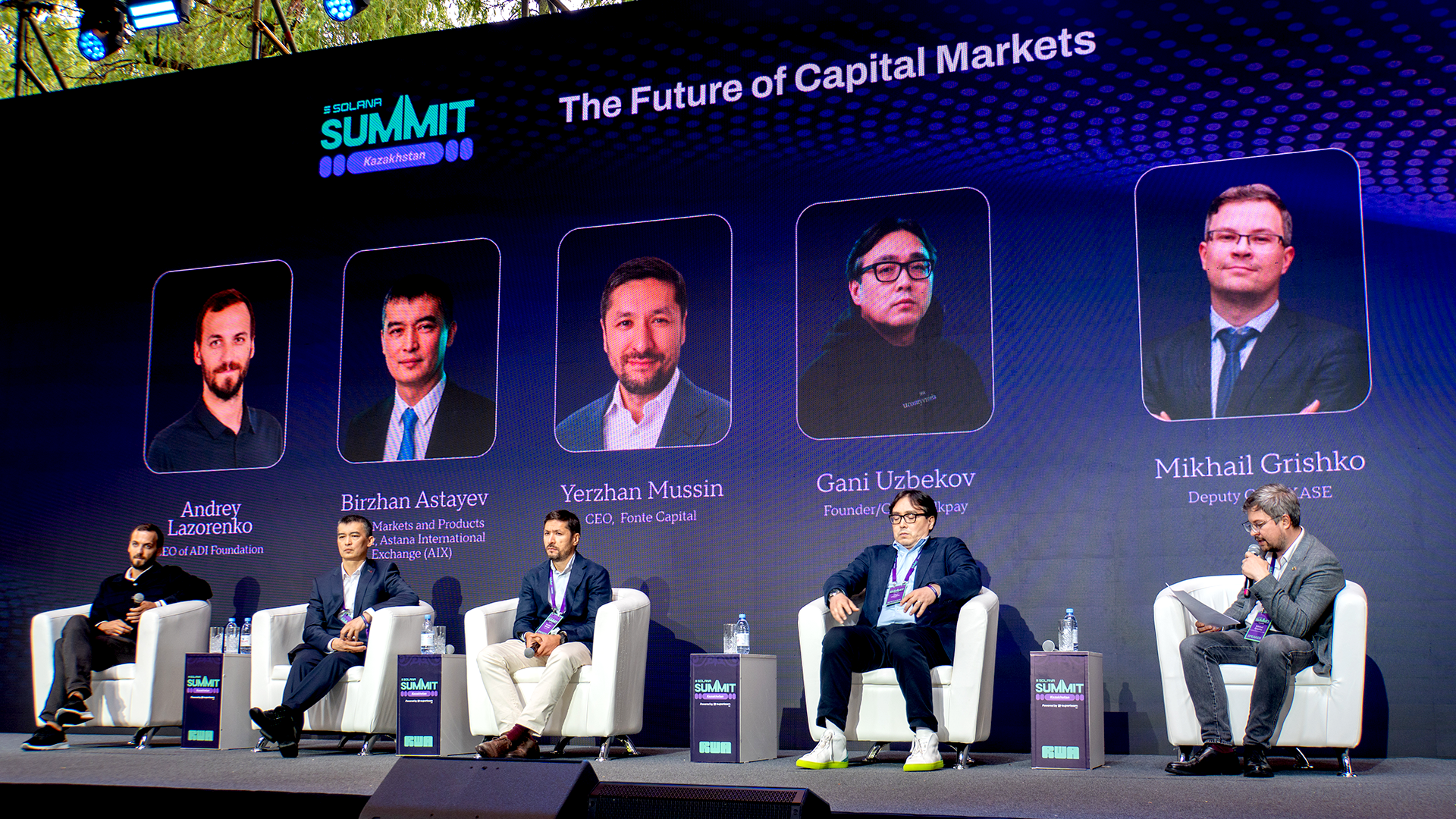
Deputy Chairperson of KASE's Management Board Mikhail Grishko moderated a panel discussion on the future of capital markets and the role of digital assets in transforming the financial infrastructure. He noted that integration of digital assets into the capital market is already a reality - crypto ETFs, digital investment products and payment solutions related to digital assets are already available in the region.
The participants discussed development of tokenization, digital asset infrastructure, stablecoins and new investment instruments.
Head of Markets and Products at Astana International Exchange (AIX) Birzhan Astayev emphasized that asset tokenization will have a key impact on the capital market. Tokens have the potential to make the market more global, accessible and continuous thanks to the ability to trade 24/7 from anywhere in the world.
ADI Foundation CEO Andrey Lazarenko discussed development of blockchain infrastructure and regional stablecoins. He stated that in the coming years, the capital markets could transition to a new settlement model based on stablecoins, and the digital infrastructure will be built around the principles of scalability, security and programmable compliance.
Fonte Capital CEO Yerzhan Musin shared his experience of launching the Kazakhstan's first Bitcoin ETF and the world's first Solana ETF with integrated staking - where the fund earns additional income by storing the digital assets and distributes it among investors. Such products are becoming a bridge between the traditional financial market and the digital asset market.
Silkpay CEO Gani Uzbekov discussed the role of prepaid cards and digital wallets in enhancing the financial inclusion. Such solutions allow people to make payments without physically moving the money, and development of stablecoins makes such operations faster and cheaper.
At the discussion's end, the participants agreed that further development of the financial market will be linked to expanded access to digital assets and introduction of more complex investment strategies.
Other events